


Interior Door and PVC Foil Coating Guide
A TECHNICAL GUIDE FROM THE MANUFACTURER

For membrane door production, the correct worktable dimensions depend first on the coating method you will use. Coating a raw door face panel, coating only the faces of an edge-banded door and wrapping the door edges with PVC foil are different applications.
This guide is intended for businesses producing or planning to produce PVC foil-coated interior doors. It covers three production methods, the vacuum membrane press worktable and foil width together. The dimensional examples relate to Makser applications; final manufacturing dimensions are determined for your project.
The first decision in membrane door production: What will be coated?
In this guide, membrane door production means applying PVC foil to CNC-profiled MDF/HDF door faces in a vacuum press. The production sequence depends on whether the foil is applied before or after door assembly and whether it wraps around the edges.
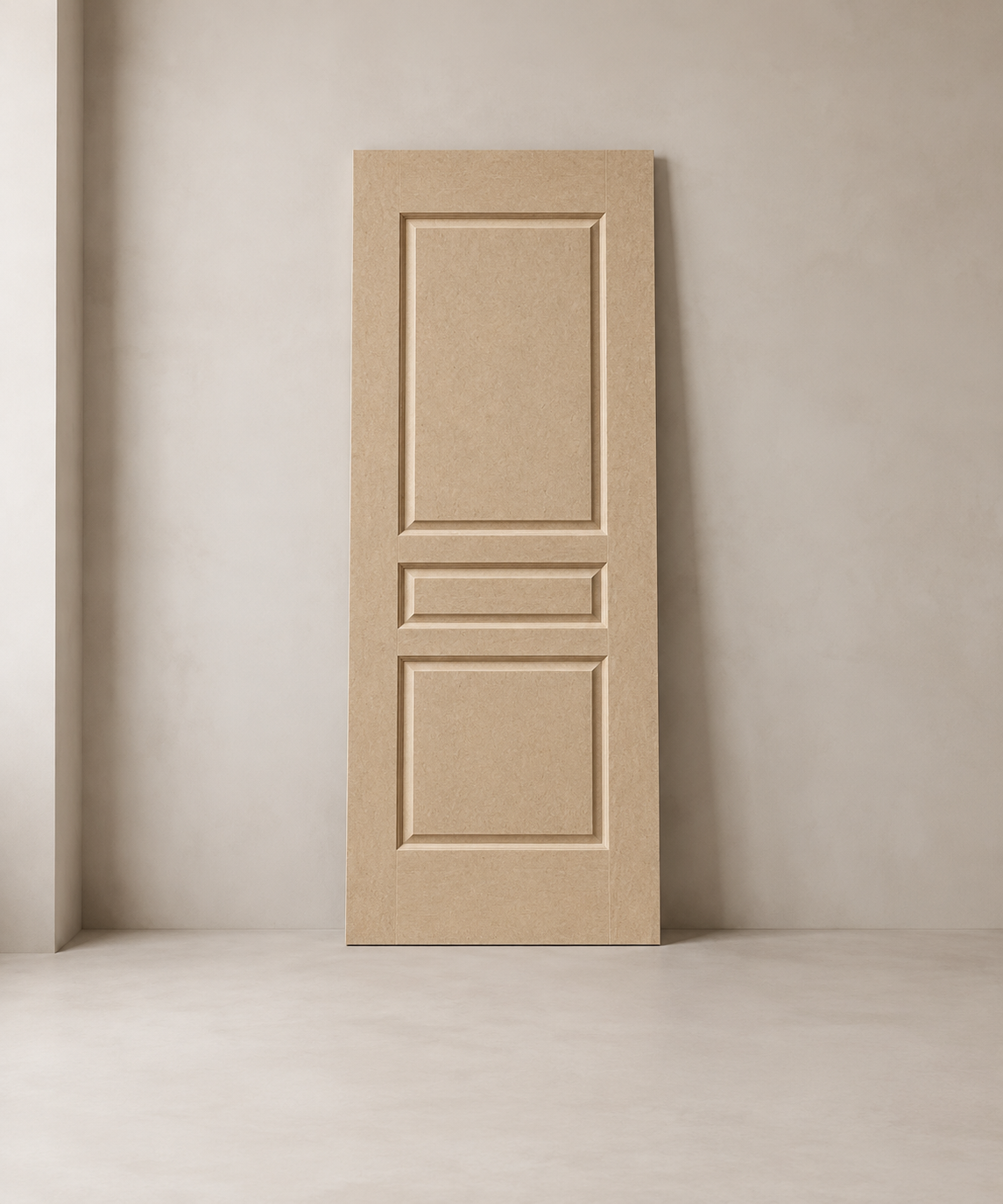
The thin face panels are coated first. The door body is assembled afterwards.
Production sequence and table dimensions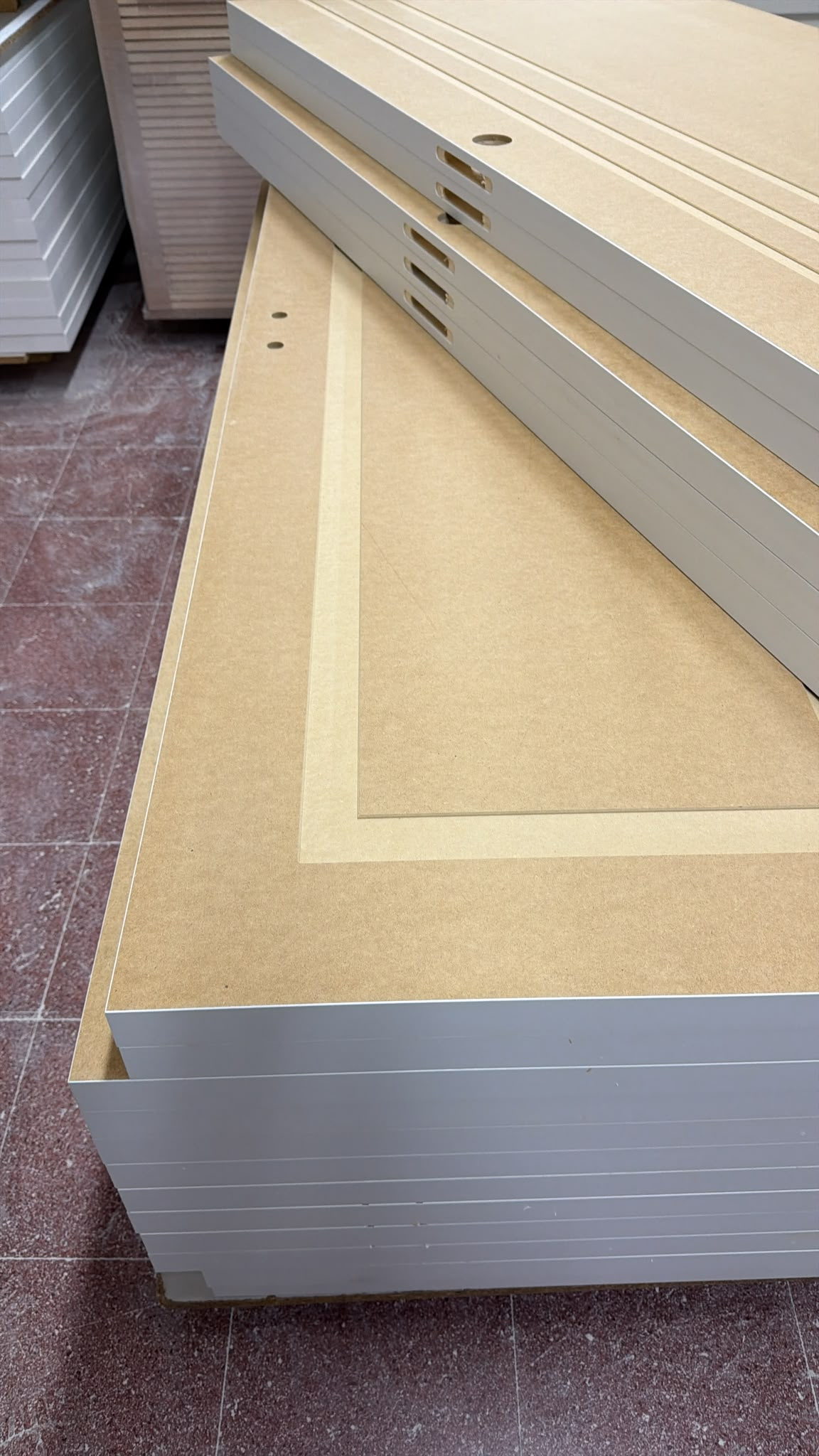
The edges are banded beforehand. The front and back faces are coated separately.
Production sequence and table dimensions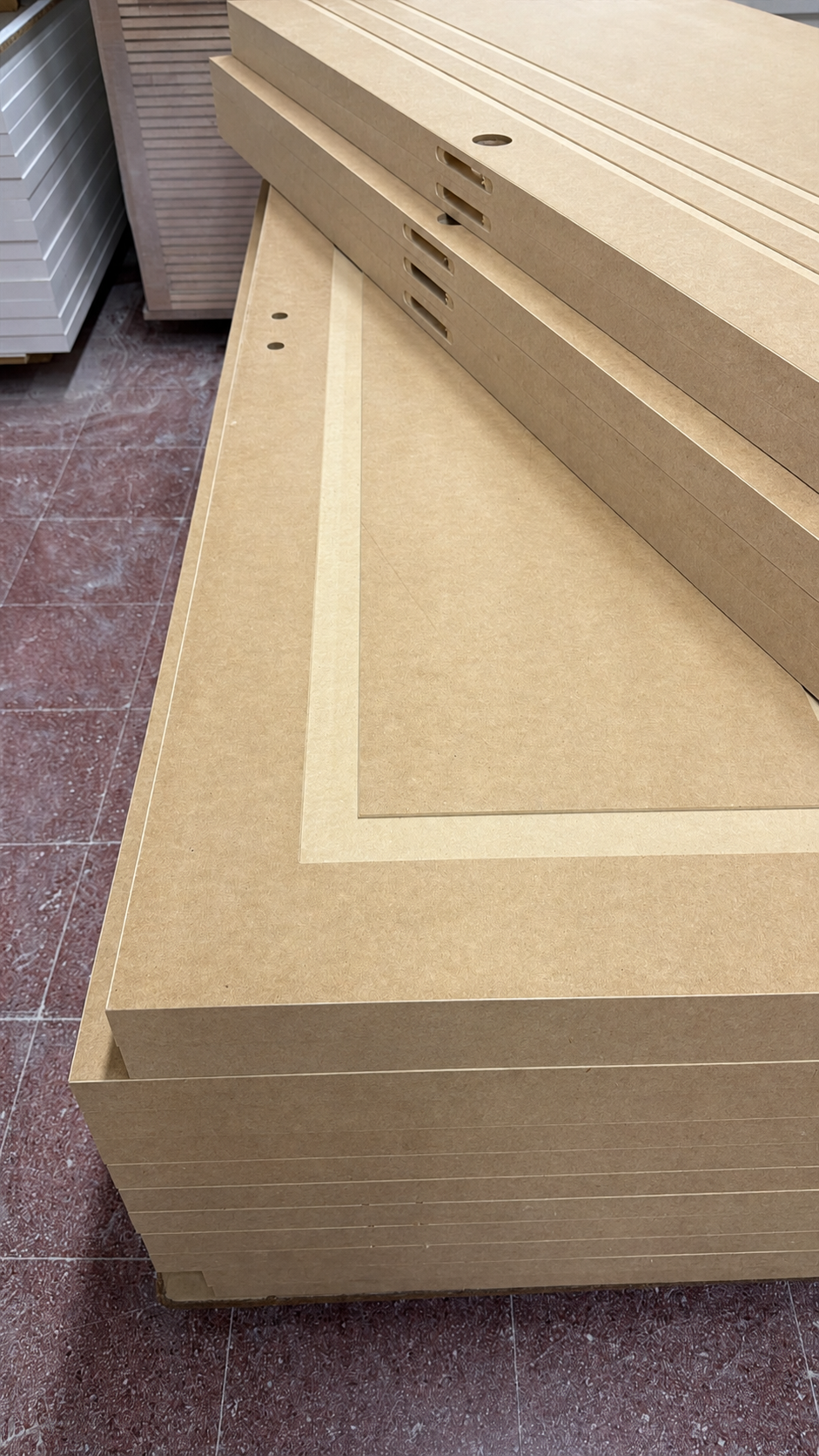
The first face is coated separately. In the second coating cycle, the other face and the edges are wrapped together.
Production sequence and table dimensionsThe images illustrate the condition of the product and its edges before coating; the handle and lock holes shown do not represent the production sequence. The raw panel colour and the unbanded-edge door example were edited with AI assistance in the earlier guide. The edge-banded door photograph is original.
The roles of CNC machining, adhesive and presses in all three methods
In all three methods covered by this guide, the door faces are profiled on a CNC router. CNC machining creates the surface pattern. A cold pressjoins the face panels to the door frame and core. The WP vacuum membrane press applies suitable PVC foil to the prepared surface. Cold pressing and vacuum pressing have different functions.
Before every vacuum pressing cycle, clean the MDF/HDF surface to be coated and apply suitable membrane press adhesive using a spray gun. Where edges are to be wrapped, prepare those edges as well. Follow the adhesive manufacturer's technical instructions for drying and readiness for pressing.
For surface profiling and coating, see our Makser RO66 CNC Router (Turkish) and WP2 vacuum membrane press (Turkish) product pages.
METHOD 1 · VERTICAL-SIDED FRAME
Coating raw door face panels: Foil first, door assembly afterwards
This method coats the panels that will form the front and back faces, not the whole door. Door face panels are commonly 4, 6 or 8 mm thick. For some glazed and special door designs, the thickness may reach 18 mm.
Production sequence
- Door faces are profiled on a CNC router.
- The surfaces to be coated are sprayed with adhesive.
- The panels are coated with PVC foil in the WP vacuum press.
- The coated panels, frame and core are assembled in a cold press.
- The door is trimmed on a door sizing machine to its final dimensions.
- Edge banding is applied.
- Handle and lock openings are machined.
Example table dimensions: 1,000 → 920 → 900 mm
For thin face panels, the table frame has vertical sides. In this example Makser frame design, an outside width of 1,000 mm leaves a net internal width of 920 mm after a total frame allowance of 80 mm. With a 10 mm clearance on each side, a 900 mm wide panel can be placed in the table.
1,000 mm outside width − 80 mm frame allowance = 920 mm net internal width
920 mm − 10 mm − 10 mm = 900 mm panel width
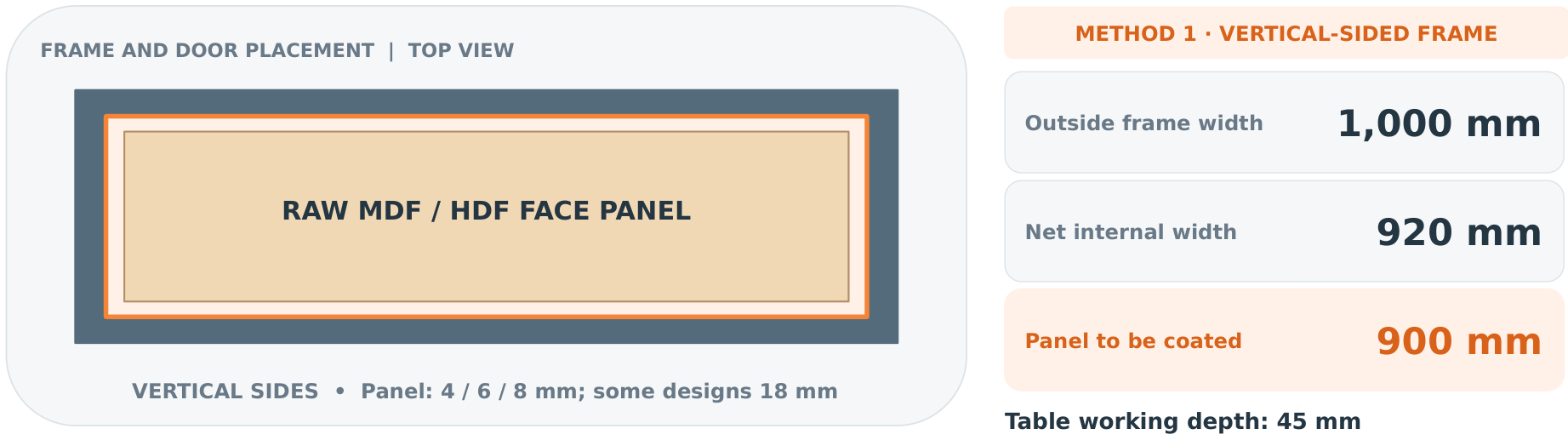
For this door face panel application, the table working depth is 45 mm. Panel thickness and table depth are not the same measurement. The length is calculated using the same placement principle as the width.
METHOD 2 · SLOPED FRAME
Coating only the faces of an assembled, edge-banded door
The door body is prepared, trimmed to size and edge-banded first. Then the front and back faces are coated separately with PVC foil in the vacuum press. There is no foil wrapping around the edges in this method; the edges have already been finished with edge banding.
Production sequence
- The faces are profiled on a CNC router.
- The door body is assembled in a cold press.
- Door sizing is carried out.
- The edge bands are applied.
- The first face is sprayed with adhesive and coated with PVC foil in the WP press.
- The other face is sprayed with adhesive and coated in a separate WP pressing cycle.
- Handle and lock openings are machined.
Why does the same outside width accommodate a narrower door?
Because the assembled door is thicker, the frame has sloped sides. This design is used to reduce the risk of the foil bursting. In the example, the total frame allowance is not 80 mm but 150 mm.
1,000 mm outside width − 150 mm frame allowance = 850 mm net internal width
850 mm − 10 mm − 10 mm = 830 mm door width
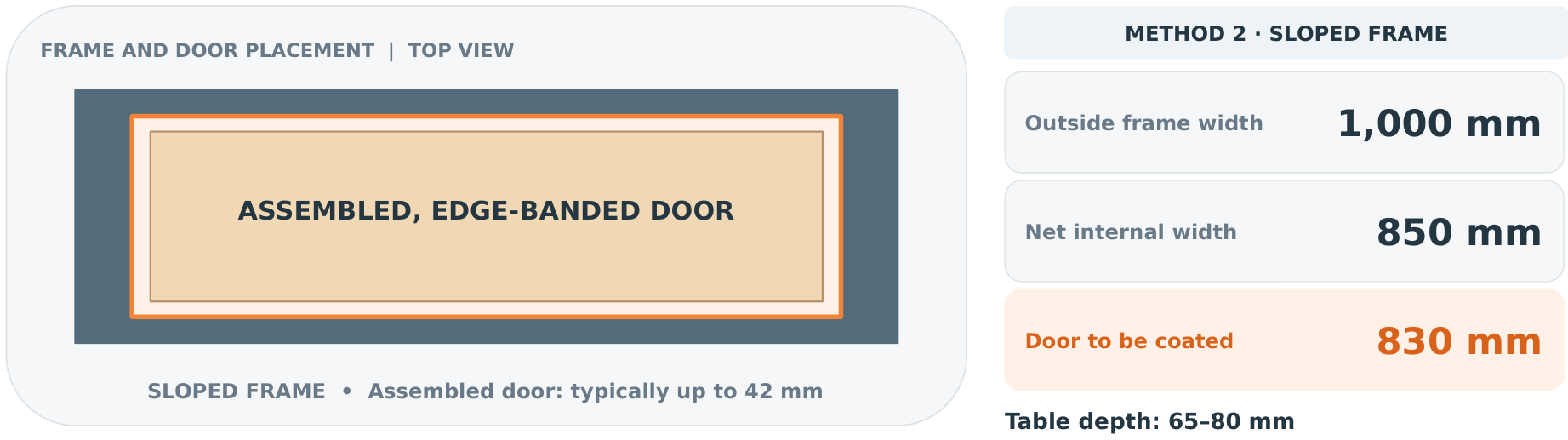
For the assembled doors considered here, the overall leaf thickness can typically reach up to 42 mm. The table working depth is set at 65–80 mm according to the customer's door thickness. Other thicknesses and geometries are assessed separately during project planning.
METHOD 3 · SLOPED FRAME + EDGE-WRAPPING CLEARANCE
Coating the faces and edges of an unbanded door with PVC foil
In this method, the door is assembled in a cold press and trimmed to size; no edge banding is applied. Foil coating is completed in two separate WP pressing cycles: the first face is coated first, followed by the other face together with the edges.
Production sequence
- The faces are profiled on a CNC router.
- The door is assembled in a cold press.
- The door is trimmed on a door sizing machine to size.
- The first face is sprayed with adhesive; only the first face is coated in the WP press.
- The other face and the edges to be coated are prepared and sprayed with adhesive; in the second WP cycle, the other face and the edges are coated together.
- Handle and lock openings are machined.
Why is clearance needed around the door for edge wrapping?
A gap is left between the door and the inner frame so that the foil can wrap around the door edges. This application also uses a sloped frame. For initial table sizing, Makser recommends a clearance of 75 mm on every side of the door.
900 mm door width + 75 mm left clearance + 75 mm right clearance
= 1,050 mm required net internal width
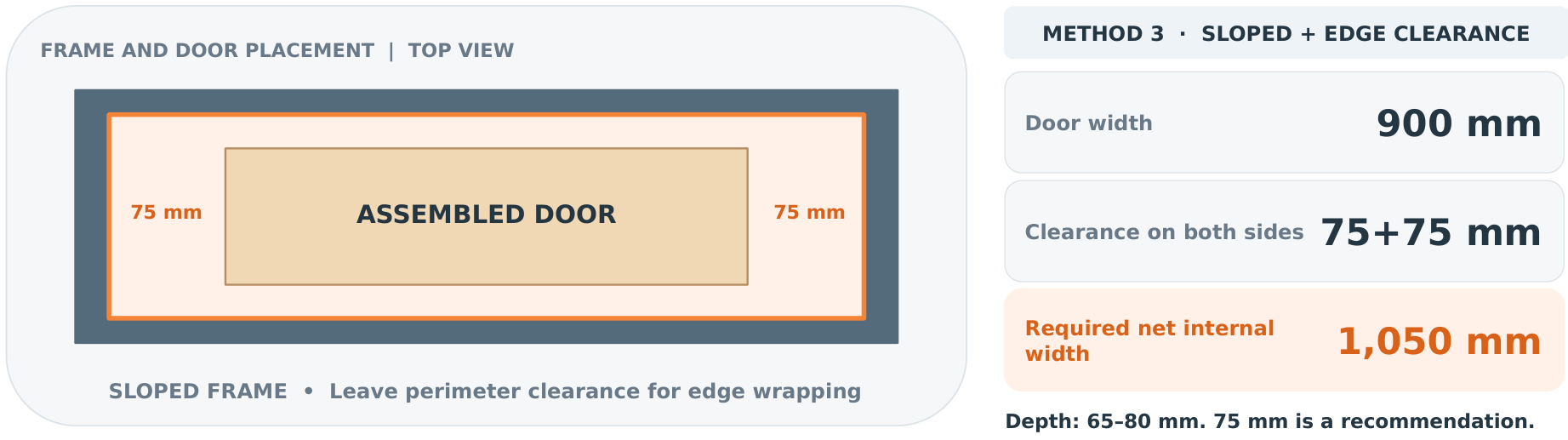
The same calculation applies to the length. For example, 2,100 mm door length + 75 mm + 75 mm = 2,250 mm net internal length is required. With these recommended clearances, a 900 × 2,100 mm door therefore requires a net internal area of 1,050 × 2,250 mm.
The outside frame dimensionsare calculated separately by adding the selected frame allowance to this net internal area. A working depth of 65–80 mm is considered according to door thickness. 75 mm is not a universal requirement; it may be reduced according to the door design, foil and application trials.
PVC foil width and slitting: How can 1,400 mm be used?
When selecting foil, distinguish between width and length. Widthis the width of the roll. Length is the amount unwound from the roll. Values such as 1,200 and 1,400 mm in this guide refer to foil width; actual dimensions and material suitability must be confirmed with the supplier.
In particular, manufacturers coating face panels in series under Method 1 can slit 1,400 mm wide foil into widths suited to the door face and frame design. The required width is used for door coating, while suitable remaining strips can be used in door frame production.
TOTAL WIDTH: 1,400 mm
These measurements indicate WIDTH. The LENGTH unwound from the roll is determined separately.
Example split: 1,000 + 400 = 1,400 mm. Cutting and edge-trimming allowances are not shown.
What is needed for slitting and frame wrapping?
Foil can be purchased pre-slit from the supplier or prepared in-house with a PVC foil slitting machine. To use suitable remaining strips on frame profiles, a profile wrapping machine is required. The strip width and material properties must suit the frame profile to be wrapped.
Some door frame designs, where their geometry and application conditions are suitable, can also be coated in a Makser WP vacuum press. This does not mean that every frame design or every remaining strip can be used in the same way.
A production arrangement that can actually use the remaining strips helps reduce discarded foil. The economic outcome depends on production volume, frame requirements, slitting costs and equipment costs.
How are the correct worktable dimensions determined?
The starting point is not just the door size you produce most often, but the largest door or face panel you will coat. Select the method first, then add the required clearances to the product width and length. Check the frame allowance, working depth and foil clamping area separately.
| Production method | Net internal width / length | Example outside frame calculation | Table depth |
|---|---|---|---|
| 1. Raw face panel | Panel dimension + 20 mm | Net internal dimension + 80 mm | 45 mm |
| 2. Assembled, edge-banded door | Door dimension + 20 mm | Net internal dimension + 150 mm | 65–80 mm |
| 3. Unbanded door; edges also coated | Door dimension + 150 mm | Net internal dimension + project-specific frame allowance | 65–80 mm |
+20 mm means 10 mm on each side; the +150 mm placement allowance means 75 mm on each side. The +80 / +150 mm frame allowances relate to example Makser designs, not fixed standards for every machine. In Method 1, use the dimensions of the panel to be coated before assembly and final sizing.
MakserTeam is the manufacturer. We can design and manufacture the worktable to your required dimensions, compatible with the foil and coating method. Rather than choosing a standard outside dimension, we start with the net internal working area you need.
Send us these details for worktable sizing
- Your chosen method: 1, 2 or 3.
- The largest door or panel to be coated: width × length.
- The product's thickness.
- The PVC foil's actual width and, if available, its thickness and technical data.
- An illustration of the door design and edge structure: a photograph or technical drawing.
If you produce more than one door range, state the maximum width and maximum length separately. They do not have to belong to the same door.
Membrane door production and table dimensions: Frequently asked questions
Do the cold press and vacuum press perform the same operation in membrane door production?
No. The cold press assembles the door body; the vacuum membrane press applies PVC foil to the prepared surface. The order of these two operations depends on the selected method.
Is a 1,000 mm outside table width enough for a 900 mm door in every method?
No. The vertical-sided frame example in Method 1 accommodates a 900 mm panel. With the same outside width, the sloped frame example in Method 2 accommodates an 830 mm door. Method 3 also requires perimeter clearance for edge wrapping.
Does 1,400 mm PVC foil refer to width or length?
In this guide, 1,400 mm refers to the roll's width. Length is the amount unwound from the roll and is determined separately according to coating and frame requirements.
What net internal width is needed to wrap the edges of a 900 mm door?
With the recommended 75 mm clearance on both sides: 900 + 75 + 75 = 1,050 mm net internal width. This is not the outside frame width.
Is a PVC foil slitting machine essential?
No. Foil can be purchased from the supplier pre-slit to suitable widths. In-house slitting requires a slitting machine. Using suitable remaining strips for frame wrapping requires separate consideration of the equipment and profile suitability.
Are all PVC foils coated at the same temperature and for the same duration?
A single setting should not be assumed suitable for every foil. Follow the foil and adhesive suppliers' technical data and the machine's application instructions, and verify production settings with appropriate trials.
Can Makser manufacture a worktable to suit my door dimensions?
Yes. A custom worktable can be designed by assessing the largest product to be coated, the method, thickness and foil width together.
Door coating and worktable sizing PDF guide
You can save or share the 6-page MakserTeam guide with your production team. It includes a visual comparison of the three methods and dimensional examples.
Open / download the PDF guideTechnical source: MakserTeam Door Coating and Worktable Sizing Guide. The diagrams are explanatory. Final dimensions, material suitability and application conditions are verified for each project.
For general background, see our article on PVC foil-coated interior door production (Turkish). Back to all MakserTeam guides.