


BLOG
How to Calculate PVC Foil Requirements for Door Production

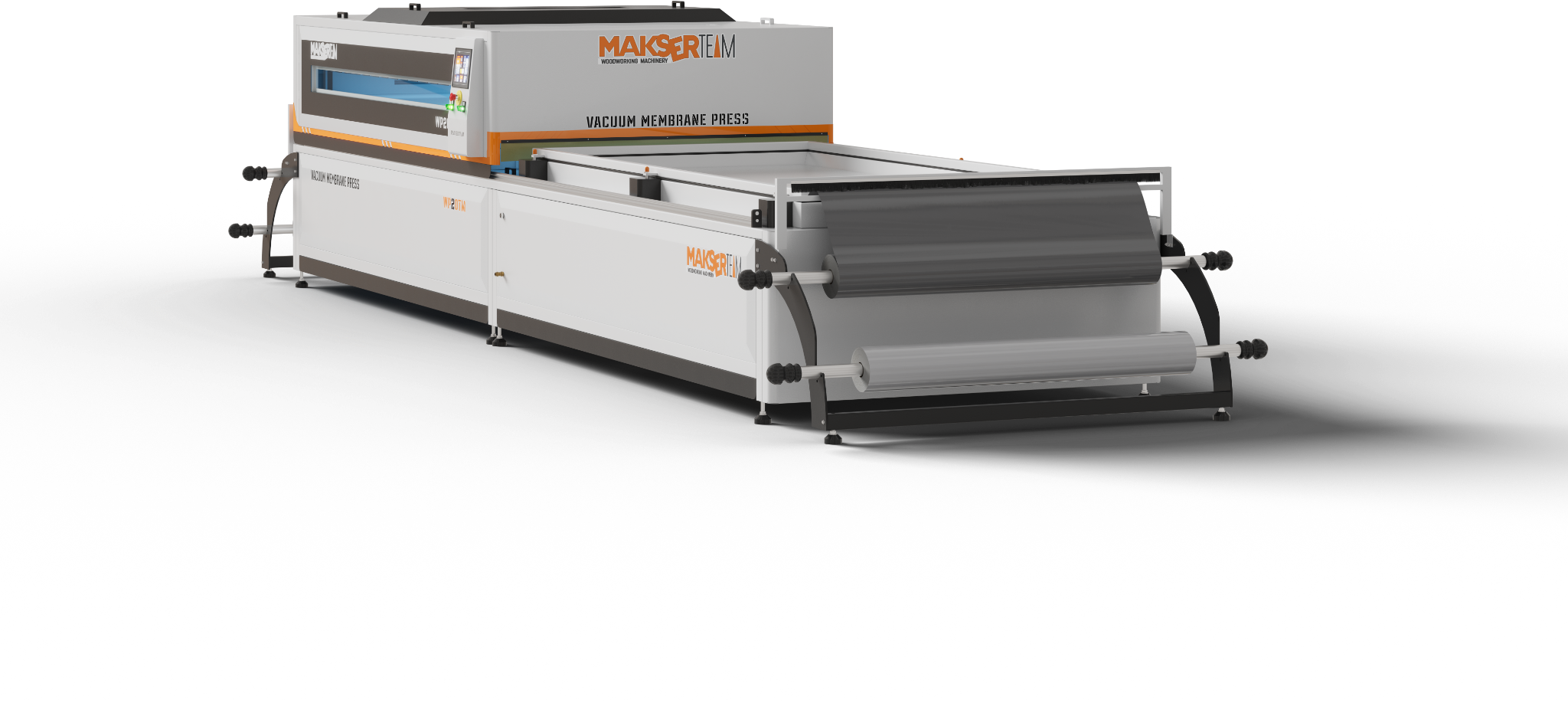
PVC foil requirements for door production depend on the coating method, the largest door or panel, the worktable and the available foil width. A correctly sized table paired with appropriately slit foil reduces unnecessary unused area. Suitable remaining strips can be used for profile wrapping to reduce overall material waste.
This guide connects foil sourcing, slitting and custom worktable sizing with consumption per draw and purchasing quantities. External table dimensions, clear internal working area, coated panel area and purchased parent-roll area are different quantities. The 1,200 × 2,300 mm calculation below is an application example, not a fixed table recommendation for every door manufacturer.
1. Start with the Coating Method and the Largest Product
Door manufacturers ordering a Makser machine specify the largest door leaf or panel they need to coat. We design the worktable around the coating method, necessary clearances, frame and available foil width. The aim is to accommodate the required product while avoiding unnecessarily large foil draws.
- Raw door face panels: Thin panels are foil-coated before the door is assembled. The numerical example in this guide uses a straight, unbevelled frame that lowers vertically.
- Assembled doors with edge banding: The front and back are coated separately. The thicker door leaf requires a bevelled frame and the corresponding internal-area calculation.
- Doors whose edges will also be foil-wrapped: A bevelled frame is combined with perimeter clearance so the foil can turn around the edges.
The production sequences and sizing details are explained in the Interior Door and PVC Foil Coating Guide. Frame and placement allowances from one method cannot simply be transferred to another.
Sizing sequence: Coating method → maximum product width, length and thickness → placement/edge-wrapping clearance → clear internal area → external dimensions including the frame and gasket area → suitable foil width and slitting plan. The widest and longest products may be different. For raw face panels, use the panel dimensions entering the press, rather than the finished door dimensions after trimming.
2. Separate the Number of Doors from the Number of Faces
If the front and back are coated separately, 2,500 doors represent 5,000 faces to coat. Establish whether an order for “5,000 units” means complete doors or individual faces before calculating material requirements.
Calculate the two faces separately if they use different foil dimensions or decors. Wrapping the edges and coating only the face may require different draw dimensions.
3. External Table Dimensions, Clear Internal Area and Panel Size
The worktable’s external dimensions are 1,200 × 2,300 mm. The foil must extend beneath the frame and be clamped against the gasket to prevent air leakage during vacuum pressing. Foil consumption in this example is therefore calculated from those external dimensions.
This numerical example concerns raw door face panels in the first method: the straight, unbevelled frame lowers vertically. Its 40 mm profiles occupy 80 mm in total across the two sides, in both width and length:
| Dimension stage | Width | Length |
|---|---|---|
| External table dimensions | 1,200 mm | 2,300 mm |
| 40 mm profiles on both sides | 1,200 − 40 − 40 | 2,300 − 40 − 40 |
| Clear internal working area | 1,120 mm | 2,220 mm |
| 10 mm positioning clearance at each edge in this example | 1,120 − 10 − 10 | 2,220 − 10 − 10 |
| Largest face panel that can be coated | 1,100 mm | 2,200 mm |
1,200 × 2,300 mm is not the maximum door size. With this frame arrangement, the largest panel is 1,100 × 2,200 mm. The foil also covers the clamping and sealing area beneath the frame.
Linear Metres and Square Metres for This Table
Convert the external dimensions to metres: 1,200 mm = 1.20 m; 2,300 mm = 2.30 m. The quantities below assume one door face/panel per draw, so coating 5,000 faces requires 5,000 draws.
| Production target | Faces to coat | Foil length | Foil area |
|---|---|---|---|
| 2,500 doors, 2 faces each | 5,000 | 5,000 × 2.30 = 11,500 m | 11,500 × 1.20 = 13,800 m² |
| 5,000 doors, 2 faces each | 10,000 | 10,000 × 2.30 = 23,000 m | 23,000 × 1.20 = 27,600 m² |
Linear metres and square metres describe the same requirement in different units. Check the supplier’s pricing unit, foil width and usable roll length together. If you must buy complete rolls, divide the required total length by the usable length per roll and round up to a whole roll.
4. Why Does an 800 × 2,000 mm Panel Still Use 2.76 m² of Foil?
Consider an 800 × 2,000 mm door face on this table. The coated panel’s net face area is 0.80 × 2.00 = 1.60 m². The foil must also extend beneath the table frame and be clamped against the gasket to create the sealed vacuum area.
| Area being calculated | Dimensions / calculation | Result |
|---|---|---|
| Net face area of the coated panel | 0.80 × 2.00 m | 1.60 m² |
| Foil used in one draw | 1.20 × 2.30 m | 2.76 m² |
| Foil area outside the net panel area | 2.76 − 1.60 | 1.16 m² |
A smaller panel does not automatically reduce foil consumption. With the same 1,200 × 2,300 mm table and frame, each draw still uses 1,200 × 2,300 mm of foil. The 800 × 2,000 mm panel must therefore be costed with the 2.76 m² consumed in that draw.
In this planar area comparison, the 1.16 m² difference includes the clamping/sealing area under the frame and the unoccupied layout area. It is already included in the 2.76 m² consumption and must not be added again as an order allowance. Defective coatings, rework and roll-end losses are tracked separately.
If several suitable parts are coated in one draw, do not count the full foil sheet again for each part. Calculate total consumption from the number of draws and allocate it to the accepted products. A bevelled frame, different profile size, edge wrapping or a different table arrangement requires the internal working area and foil dimensions to be reassessed.
5. PVC Foil Width, Slitting and Profile Wrapping
Sourcing 1,200 mm and 1,400 mm Foil
Common PVC foil roll widths in door production include 1,200 mm and 1,400 mm. In Makser’s recent sourcing experience, ready-made 1,200 mm wide foil has become harder to obtain. Before ordering a machine, check the widths available for the required decors and whether the supplier offers slitting. These figures describe roll width; the length drawn is calculated separately.
Why Plan for 1,400 mm Foil When Slitting Is Unavailable?
If ready-made 1,200 mm foil cannot be sourced, there is no in-house slitting and the supplier cannot provide slit rolls, the available 1,400 mm roll is used at full width. In this production arrangement, the table and frame are designed around the 1,400 mm foil width; this is not the clear internal working width. With narrower door panels, the large area outside the product consumes additional foil on every draw.
At the same 2.30 m draw length, full-width foil uses 1.40 × 2.30 = 3.22 m². A 1.20 m strip and matching table use 2.76 m². The difference is 0.46 m² per draw, or 2,300 m² over 5,000 draws. This comparison assumes the same coating job is suitable for both table arrangements.
Match the Door-Sized Table to the Slit Foil
This is why series door manufacturers often work with slit foil. Rolls can be prepared on an in-house PVC foil slitting machine or ordered from the supplier in the required width. Makser sizes the table to the customer’s largest door/panel and coating method; the foil must also extend beneath the frame and clamp against the gasket. The slit width must not be based on the door width alone.
For example, the straight-frame arrangement in the main method guide uses a 920 mm clear internal width and a 1,000 mm external width for a 900 mm panel. A corresponding slitting example is 1,400 = 1,000 + 400 mm: the 1,000 mm strip serves door-face coating, while the suitable 400 mm strip is assigned to profile wrapping. For a table requiring 1,200 mm foil, the example becomes 1,400 = 1,200 + 200 mm. The width depends on the largest required product; these table sizes are not interchangeable.
Remaining Strips Can Be Used on Profile Wrapping Machines
Suitable strips from slitting can be used on profile wrapping machines to coat door-frame components and other compatible profiles. Strip width, decor and technical properties must match the profile’s developed wrapping width, adhesive and wrapping process. This is a separate production process from coating door faces in a vacuum press. Track usable strips against profile-wrapping demand instead of treating them immediately as waste.
Calculate Purchased Parent Rolls and Press Strips Separately
The earlier example of 5,000 draws requires 11,500 linear metres. Slitting that length of 1,400 mm parent roll into 1,200 + 200 mm gives:
| Material allocation | Calculation | Area |
|---|---|---|
| Purchased 1,400 mm parent roll | 1.40 × 11,500 | 16,100 m² |
| 1,200 mm strip assigned to door coating | 1.20 × 11,500 | 13,800 m² |
| 200 mm strip to assess for profile wrapping | 0.20 × 11,500 | 2,300 m² |
Slitting does not reduce parent-roll purchases from 16,100 m² to 13,800 m² in this example. It allocates material between door coating and another use. Overall waste is reduced by matching the table to a smaller foil draw and actually using the remaining strip for profile wrapping. Unusable strips are recorded separately as losses.
These slitting examples are geometric allocations excluding cutting and edge-trimming losses. A 200 mm or 400 mm strip does not fit every profile; the final slitting plan follows actual production requirements.
6. An Extra Order Allowance Is Different from a Loss Rate
Trials, recoating, unusable roll ends and other production losses may increase the base requirement. Set the additional requirement using your own production records. Do not add layout allowances already included in the measured draw dimensions as waste a second time.
| Definition | Illustrative 5% calculation | Result |
|---|---|---|
| Add 5% to the base requirement | 13,800 × 1.05 | 14,490 m² |
| Assume 5% of purchased material is lost | 13,800 ÷ 0.95 | Approximately 14,526.32 m² |
The 5% value only illustrates two different definitions. It is not a MAKSER standard or a recommended waste rate. Do not apply both methods to cover the same loss.
7. Keep a Separate Stock Line for Each Size and Decor
Record the following together: decor/product code, coating method, panel size, external table dimensions, frame type, face/draw count, parent-roll width, slitting plan, press-strip width, draw length, total linear metres and m², strip quantity allocated to profile wrapping, actual waste, additional requirement and existing usable stock. Stock in one decor cannot fulfil an order for another.
8. Combine Custom Door-Table Sizing with WP2/WP4 Selection
Makser can design the worktable to the manufacturer’s largest door leaf or face panel. The coating method, thickness, clear internal area, frame/gasket allowance and available foil supply are assessed together. Where slitting is available, table and strip widths are matched to reduce unnecessary empty area. The area needed for the largest product is retained, while frequently produced smaller parts receive a separate layout assessment.
The WP2 vacuum membrane press has two worktables, allowing one to be prepared while coating takes place on the other. More tables do not automatically reduce the foil area needed for a single door face.
The smaller centre table on the WP4 vacuum membrane press can be considered for suitable small parts and short runs. A material advantage depends on the parts fitting that table and an actually smaller foil sheet being drawn. Do not assume a full-size interior door will fit the small table.
Reducing the working area with a separator can also be assessed for suitable equipment. Reducing the active vacuum area alone does not reduce foil consumption if the same sheet width and length are still used. See the Interior Door and PVC Foil Coating Guide for coating methods and frame sizing.
Frequently Asked Questions
How many square metres of PVC foil does one door need?
Consumption depends on the table/frame arrangement and the actual foil drawn. In this example, two separate draws on the same 1,200 × 2,300 mm table, with one face coated per draw, use 2 × 2.76 = 5.52 m². The door’s net face area is a different quantity.
How do I convert foil length to square metres?
Multiply total length in metres by width in metres. A 100 m length of 1.20 m wide foil equals 120 m²; the same length at 1.40 m wide equals 140 m².
Can I use the door’s net face area as the purchase quantity?
Net face area alone excludes frame, layout and process allowances. Use actual draw dimensions and, where relevant, the parent-roll slitting calculation for purchasing.
Is a remaining strip automatically a saving?
No. Confirm that it can be used for another suitable job and track its quantity and decor in stock. Record actual reuse separately from the theoretical remaining area.
What if 1,200 mm foil is unavailable?
A 1,400 mm parent roll can be slit in-house or by the supplier to suit the table and frame. If slitting is also unavailable, this production arrangement is planned for the full 1,400 mm foil width, with table dimensions and consumption calculated accordingly.
Can Makser size the table to my door leaves?
Yes. The largest door/panel, coating method, thickness, frame and foil supply are evaluated together to design the worktable. The aim is to provide the required working area while reducing unnecessary foil use.
What can the remaining slit foil be used for?
Suitable strips can coat door-frame components and other compatible profiles on profile wrapping machines. Width, decor and technical suitability must be checked. Record actual use separately from unusable waste.
Let’s plan around your doors and production
Share the width, length and thickness of your largest door/panel, your coating method, monthly production, available foil widths and access to slitting. If you also wrap profiles, include the required strip widths. We can plan the worktable and foil allocation together.